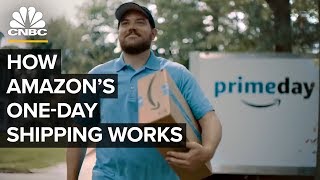
For the past few years delivery boxes have been piling up on people's
doorsteps and in apartment buildings across the U.S.
Faster delivery, easier return policies and free shipping have fueled
growth in the retail e-commerce market.
Amazon alone shipped over 5 billion packages through Prime in 2017 and
in 2019 announced they are expanding their one-day delivery service
to over 10 million products.
The corrugated box is a great medium for transporting things because
it's durable and sturdy and from a damage standpoint you're going to
have less risk of that getting damaged in the supply chain.
A corrugated box is the brown paper box that is used to ship roughly
95 percent of all products in the U.S.
The corrugated boxes is probably the single best mousetrap to get
goods from point A to point B, its recyclable and returnable
reusable. Shipping cost Amazon $27 billion in 2018 which is more than
double the amount it spent in 2015.
That growth has been great news for the paper and packaging industry
after the move to digital devices caused a drop in production of copy
paper and newsprint.
There's no question that it's, I don't want to call it a salvation but
it's been a ray of sunshine a point of visible growth within
companies where other segments of their business were clearly in
decline.
Amazon has been blamed for everything from the death of brick and
mortar retail to the financial woes of the post office.
But the rise of e-commerce shipping boxes has provided a boost to the
stagnant cardboard box market.
The box business now faces a new challenge from lighter and cheaper
plastic packaging that has proliferated in recent years due to a
transformation in the way packages are shipped.
And as Amazon tries to cut down its carbon footprint the
containerboard industry is bracing for the fallout.
Which begs the question with multiple headwinds on the horizon will
paper based cardboard boxes that have been used for generations and
thrived in the age of e-commerce continue to flourish or could the
cardboard box be facing a new challenger?
Cardboard boxes are a really big deal in the U.S.
The United States is the Saudi Arabia of trees.
Someone's gonna make the first box and that's almost inevitably a
mill generally in the Southeast United States.
China certainly doesn't have trees and India the extent they do have
trees they're not necessarily the right types of trees and shouldn't
be dedicated towards making boxes for us.
The box business grew rapidly up through 1999 when the U.S.
coordinated box market had its peak shipment. Starting
in the early 2000s the U.S.
corrugated box market faced multiple economic obstacles. The
great recession dragged on box demand and even after the recession
demand continued to slow for consumer goods like soda and for the
boxes that transport them. The
move to digital devices also coincided with a drop in demand for copy
paper and newsprint.
But box makers found a saving grace in e-commerce sales and Amazon
sale specifically which were growing at mostly double digit rates in
the recession and post-recession years.
Those e-commerce sales have become a significant market for the
containerboard industry. In
2018 told a U.S.
e-commerce sales were estimated to be $512 billion almost 50 percent
higher than in 2015.
Amazon captured 48 percent of those sales.
Most estimates are that e-commerce accounts for about 10 percent of
the U.S.
box market.
Amazon accounts for close to 5 percent of U.S.
box demand.
By our estimates they are clearly the single largest box user in the
US. International Paper with a third of the market I think does
closer to 50 percent of all the amazon boxes evidently they got a bit
more share than perhaps some of the smaller players.
Amazon said they deal with most of the big box makers across the U.S.
according to analysts.
Those manufacturers include International Paper, WestRock, Packaging
Corporation of America and Georgia-Pacific.
Some investors were turning to these companies as a way to invest in
the e-commerce giant without having to purchase Amazon's pricey
stock.
People didn't really start talking about buying International Paper or
WestRock as a secondary investment in Amazon till about the last five
years.
Despite the boost from e-commerce sales the box business still isn't
growing all that much.
And since 2018 their stocks have mostly underperformed the S&P
500. In 2018, 69 percent of International Papers total revenue came
from the box business and that sales volume has been mostly flat for
the past five years.
Although the big producers sold less boxes in 2018 than in
2000, industry consolidation has dramatically narrowed the fields.
The handful of big players remaining are based in Memphis, Tennessee,
Atlanta, Georgia and Lake Forest, Illinois.
Analysts have told CNBC that substantial industry mergers have made
it easier to collectively hike prices and those price increases have
helped drive revenue.
There are portions of the business that are in indisputable secular
decline but if you're in the brown part of the business, making these
boxes, that's been some very welcome growth.
But those extra boxes piling up on people's doorsteps have led to a
backlash from disgruntled customers who are sick of receiving golf
ball sized products in supersized boxes.
It used to be that you'd order a toothbrush and it would come in three
giant boxes and you'd say to yourself, what is this?
Well, Amazon is trying to rectify that by using fewer boxes and using
other types of packaging where appropriate.
With e-commerce packaging underfire Amazon decided to change the way
they do shipping.
In 2008, Amazon introduced the Frustration Free Packaging program.
It aims to reduce the extra packaging created when retail packaged
products are placed inside Amazon boxes to be shipped.
Instead, products certified in the program that are roughly the size
of a blender or larger need to be packaged in their own ready to ship
boxes. And those boxes also need to be made of 100 percent recyclable
materials. For customers that means that the packaging is easy to
recycle and the box is easy to open without all the excess packaging
materials.
For a year.
Amazon offered vendors an incentive of a dollar per shipment to
modify their packaging.
And starting August 1st 2019 Amazon is charging a $1.99 penalty
for each product shipped that needs to be reboxed. And
basically the point of this deadline is for Amazon to get out of the
business of packaging.
They want their vendors to send them boxes that Amazon doesn't have to
touch or rebox.
Amazon says that in the 10 years since its rolled out the program in
2008, it saved them from shipping out 500 million shipping boxes and
reduced their packaging materials by 244,000
tons. Even corrugate waste that can be properly recycled is still a
burden placed on the customer to tear down and properly recycle
so this is just a recognition that we want e-commerce to be the most
sustainable easiest choice for our customers.
In those shift by Amazon have made the corrugated industry rethink the
way it does business.
International Paper said in an email to CNBC, "At the start of the
Ecomm boom it was really difficult to forecast demand.
There is a big focus on improving efficiencies through right sized
packaging."
But, with Amazon using fewer and smaller cardboard boxes in the future
that could prove to be bad news for the box makers.
Before Amazon launched Prime in 2005 free two-day shipping wasn't a
thing. Today it's the norm.
In an effort to reduce costs and ship out an ever increasing number of
products faster Amazon moved to plastic mailers and plastic bags for
many of its smaller products. If
your shipping clothes that don't need to be in boxes they can go in a
flexible plastic mailer.
As a result of which you've seen more and more products go into
flexible plastic mailers.
Over the past year or so it's just part of Amazon's overall effort to
reduce its costs.
Over the last few years we've recognized that there is a great role to
play for flexible packaging of all types and we've reduced our
overall corrugate and shifted many of our smaller items to being
shipped out bound in flexible packaging.
It's made a pretty profound difference we've reduced substantially
our use of corrugate box. Sealed Air a
packaging company that invented bubble wrap in 1957 started working
with Amazon in 1996 developing inflatable pillows for the company to
ship books.
The evolution of packaging for e-commerce it really started off quite
basic. Whatever item you received you received it in packaging that
was probably designed to ship on a pallet and go to a retail store.
What e-commerce companies did was they take those items and they put
it into another box.
What's evolved is you now see a lot more flexible packaging.
There is a lot of competition in the mailer market in generally
mailers are a low margin product.
As of 2019 Sealed Air a leader in the protective packaging market
makes food packaging, air pillows and automated packaging systems for
e-commerce. Sealed Air had a revenue of $4.7 billion
dollars in 2018 up modestly from a revenue $4.5 billion
dollars in 2010.
When you think about the challenges that e-commerce fulfillment
companies face it's really in shipping expense because if you give
away shipping I mean someone's paying for that and it typically is
the e-commerce fulfillment company.
There is a lot of desire to decrease the amount of labor, when you
are able to get it, it's hard to retain it and it's
expensive, automation has really been where we have spent a great
deal of our time investing.
Around 2010, Amazon started using Jiffy padded envelopes with Kraft
paper on the outside in plastic bubbles on the inside.
Over the last two years we have invented two different kinds of
flexible mailers.
One is the blue and white all plastic mailer.
We've recently launched in the last six, eight months a paper padded
mailer that's actually fully recyclable with the paper stream.
Amazon said they made about 10 million shipments using the paper
padded mailer and depending on the month the plastic mailer is used
about 20 to 30 percent of the time.
So really when we come down to deciding if the product is of the size
it can go on a mailer, it's not likely to be damaged by going in the
mailer, the mailer is always the better fitting option and frankly is
easier for the customer to choose to recycle than breaking down a
corrugate box.
We're driving in that direction for many different reasons. But
those plastic mailers generally are not accepted in municipal
recycling programs and you'll need to bring them to a store that
accepts plastic bags.
Many cities have film recycling and take back programs
through stores then that plastic mailer makes sense but we've
basically moved away from a non-recyclable to two recyclable
options. Plastic mailers have some benefits for the environment. A
corrugated box uses 23 times more energy and produces six times more
CO2 than a bubble mailer to manufacture. Plastic
mailers take up less space in containers and trucks making shipping
more efficient.
But in the paper versus plastic debate not everyone agrees.
Environmentalists argue in practice the plastic mailers aren't better
for the environment.
They say these products need to be recycled separately from other
plastics and they aren't recyclable in curbside bins.
Two huge barriers to recycling. The
latest stats from the EPA show that corrugated boxes were recycled at
a rate of 92 percent in 2015 while plastic bags, sacks and wraps were
recycled at a rate of 13 percent in 2015.
When you think about what is the greatest pain point for the consumer
after having it get there safely arrive on time people are concerned
about receiving something that is plastic or made a poly because of
the environmental concerns.
Some waste management companies say plastic packaging also causes
problems for the recycling systems.
Plastic mailers get caught in the recycling machinery slowing down
the process and raising the costs for recyclers and sometimes
contaminating entire bundles.
Until Scotty on the Enterprise can beam the products from the
warehouse to your living room I think Amazon's gonna be good for the
corrugated business.
I think there's going to be noise I think you're gonna have
challenges from time to time where people say, "Should we try and the
plastic pouch?",
in the long run plastic is gonna be on the wrong side of
history. Because Amazon is a market leader in the U.S.
e-commerce sector any move away from cardboard to plastic mailers
could signal a shift for the entire industry.
The corrugated box could be about to undergo a major facelift.
We're seeing some major trends among consumers and what they're
expecting from e-commerce and the first one is actually this desire
for increased engagement with the package.
In 2015, Amazon partnered with Universal Pictures and Illumination
Entertainment to ship orders in bright yellow delivery boxes
featuring cartoon characters from the movie Minions.
The boxes promoting the movie and a special Amazon U.R.L.
dedicated to shopping for merchandise from the film.
If a millennial is going to look at it and it's gonna be an Instagram
moment then we need to be thinking about what can we do with the
package to help foster that. At
Amazon an engineering team is working on redesigning the cardboard
box. In 2018, using computational engineering they began to test the
stress and strains and vibration effects of packages as the moving
trucks across the country.
We've optimized the weight of the corrugate box and reduced the
overall weight of our boxes by about 9 percent. And
we've reduced the size of our box meaning making them fit better and
our customers are seeing in some cases much of an 18 to 20 percent
reduction in the weight of the recycled
corrugate waste that they would have seen coming into their home.
While items like clothing and diapers can ship in a plastic flexible
mailer, electronics and easily damaged goods will still need the
protection offered by a corrugated box.
Despite headwinds in the economy and inroads from plastic mailers
demand for cardboard boxes from Amazon continues to remain high.
Even though Amazon is using some smaller boxes, the four companies
that I mentioned have not been talking about less demand from Amazon
they're talking about more demand from Amazon.
And if it's smarter demand from Amazon I still think they're to get
paid for that. With
U.S. online retail sales expected to surpass a trillion dollars by
2025, double the amount it reached in 2018, the market for e-commerce
packaging could increase rapidly in the coming years despite Amazon's
effort to cut down its shipping footprint. E-commerce
packaging which includes corrugated packaging as well as flexible
packaging will grow at about 14 percent every year from 2017 through
2022 reaching almost $55 billion in 2022.
That growth could deliver sizable returns for the cardboard box
makers and we're likely to see even more boxes and plastic mailers
piled outside of people's homes in the future.